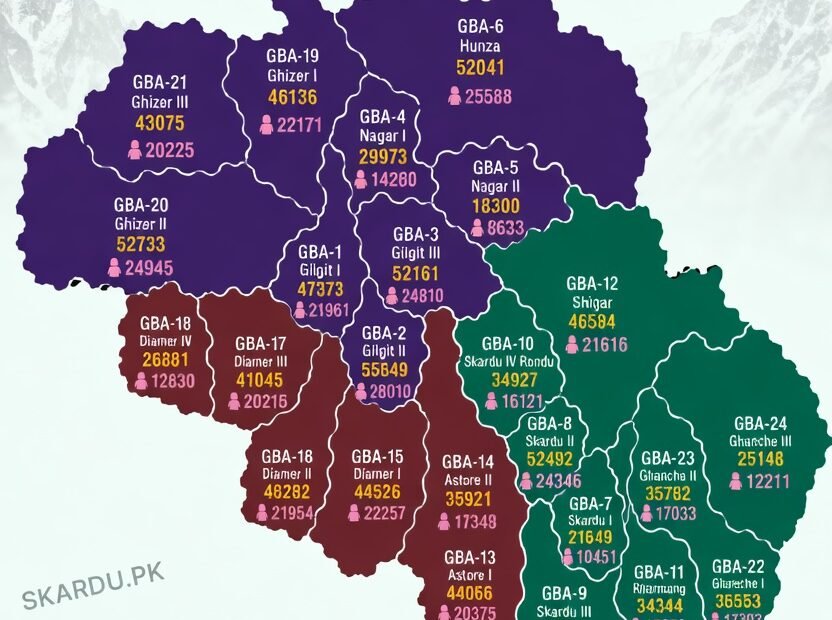
With the release of the Final Electoral Roll 2026 by the Election Commission Gilgit-Baltistan, the region heads into the upcoming elections with a total of 958,480 registered voters, setting the stage for one of the most closely watched political contests in recent years.
The data not only highlights the size of the electorate but also exposes sharp variations in constituency strength, gender balance, and electoral influence across the region.
𝐍𝐞𝐚𝐫𝐥𝐲 𝐎𝐧𝐞 𝐌𝐢𝐥𝐥𝐢𝐨𝐧 𝐕𝐨𝐭𝐞𝐫𝐬 𝐑𝐞𝐠𝐢𝐬𝐭𝐞𝐫𝐞𝐝
The final voter list shows:
- Male voters: 503,772
- Female voters: 454,708
- Total voters: 958,480
Women make up approximately 47.4% of the electorate, reflecting relatively strong female participation compared to many other regions. The overall gender gap stands at 49,064 voters, with males at 52.6% and females at 47.4%.
𝐋𝐚𝐫𝐠𝐞𝐬𝐭 𝐂𝐨𝐧𝐬𝐭𝐢𝐭𝐮𝐞𝐧𝐜𝐢𝐞𝐬 𝐢𝐧 𝐆𝐁 𝟐𝟎𝟐𝟔
Several constituencies stand out due to their large voter bases, making them key battlegrounds in the upcoming election.
Top five largest constituencies:
- GBA-2 Gilgit-II — 55,849 voters
- GBA-20 Ghizer-II — 52,733 voters
- GBA-8 Skardu-II — 52,492 voters
- GBA-3 Gilgit-III — 52,161 voters
- GBA-6 Hunza — 52,041 voters
These constituencies are expected to be highly competitive due to their dense and politically significant electorates.
𝐒𝐦𝐚𝐥𝐥𝐞𝐬𝐭 𝐂𝐨𝐧𝐬𝐭𝐢𝐭𝐮𝐞𝐧𝐜𝐢𝐞𝐬
At the lower end of the scale, several constituencies have relatively small voter populations:
- GBA-5 Nagar-II — 18,300 voters
- GBA-7 Skardu-I — 21,649 voters
- GBA-24 Ghanche-III — 25,148 voters
- GBA-18 Diamer-IV — 26,861 voters
- GBA-4 Nagar-I — 29,973 voters
The disparity is significant, with Gilgit-II holding more than three times the voters of Nagar-II, underscoring uneven demographic distribution across the region.
𝐄𝐥𝐞𝐜𝐭𝐨𝐫𝐚𝐥 𝐇𝐞𝐚𝐯𝐲𝐰𝐞𝐢𝐠𝐡𝐭𝐬: 𝐃𝐢𝐚𝐦𝐞𝐫, 𝐆𝐢𝐥𝐠𝐢𝐭, 𝐒𝐤𝐚𝐫𝐝𝐮 𝐚𝐧𝐝 𝐆𝐡𝐢𝐳𝐞𝐫
Four districts dominate Gilgit-Baltistan’s electoral landscape, collectively accounting for 598,788 voters (62.5%) of the total electorate.
- Diamer: 158,714
- Gilgit: 155,383
- Skardu: 142,747
- Ghizer: 141,944
Together, these districts form the core political battlegrounds that are likely to determine the overall direction of the GB Election 2026.
𝐆𝐞𝐧𝐝𝐞𝐫 𝐁𝐚𝐥𝐚𝐧𝐜𝐞 𝐚𝐧𝐝 𝐕𝐨𝐭𝐞𝐫 𝐃𝐢𝐯𝐢𝐝𝐞𝐬
Closest Gender Parity
GBA-15 Diamer-I stands out as the most balanced constituency:
- Male voters: 22,269
- Female voters: 22,257
- Difference: just 12 voters
This near-equal distribution is rare and indicates almost perfect gender parity.
Largest Gender Gaps
The widest differences between male and female voters are seen in:
- GBA-2 Gilgit-II — 3,829
- GBA-8 Skardu-II — 3,800
- GBA-12 Shigar — 3,362
- GBA-20 Ghizer-II — 2,843
- GBA-3 Gilgit-III — 2,541
𝐖𝐡𝐞𝐫𝐞 𝐖𝐨𝐦𝐞𝐧 𝐂𝐨𝐮𝐥𝐝 𝐃𝐞𝐜𝐢𝐝𝐞 𝐑𝐞𝐬𝐮𝐥𝐭𝐬
Constituencies with the highest female voter strength include:
- Gilgit-II — 26,010 women voters
- Hunza — 25,588
- Ghizer-II — 24,945
- Gilgit-III — 24,810
- Skardu-II — 24,346
In these areas, women voters are expected to play a decisive role in shaping outcomes.
As campaigning intensifies, these electoral patterns highlight where political parties are likely to concentrate their efforts. The GB Election 2026 is shaping up to be a contest where constituency size, gender dynamics, and regional balance will all play a critical role in determining the final outcome.